Failed perfectionists

When experiencing the ‘set-backs’ ADHD can pose on someone, it’s very easy to feel as if we’re underachieving in contrast to our ‘neutrotypical’ counterparts. This can often have two effects; shutting down or setting unattainable expectations for ourselves. Opting for the latter can be extremely self-sabotaging, as when we set these impossible standards, we’re particularly self critical and rarely actually meet these standards producing an inferior result to normal. In essence we become sort of failed perfectionists .

For example, as a student, I never felt like I was level with my peers. I always felt like their work ran laps around mine, even though I knew just as much as they did on a given subject, it just never translated. Of course this would affect my grades, and I was obsessed with the notion that I was simply an underachiever. In response, when I had assignments to complete over a school break, I would always tell myself that the assignments just weren’t enough. Furthermore, with more and more influences of social media, I also felt pressure to look perfect and lead the perfect lifestyle, just like the facade that influencers create. So, as soon as I had any sort of school break (Holiday or weekend) I would constantly self-sabotage by telling myself I have to use my time to achieve more. For instance, I would plan to do these assignments, plus thirty hours of revision, re-write essays to make them as good as my classmates, plus work out everyday, clear my skin, and clean my whole room and read a whole book….. In a week! Surprise surprise none of these would get done, not even the assignments which were the priority of the week. Every morning I would wake up entirely overwhelmed by the unnecessary expectations I had set for myself and procrastinate by any means necessary until the next day rolled around. As these days went by, I would feel the accumulating pressure of the lost time and feel a lot of guilt and low self esteem. Looking back on it I’m not so sure how I didn’t recognise this pattern and repeated it every school break up to my final year. Now, this got especially frustrating during COVID. At first, it was a surprise two weeks without school, so of course I had set out a whole list of goals I absolutely had to achieve and did none of them. As time went on, with a combination of assignments piling up and my lack of motivation from being at home 24/7, I was seriously contemplating dropping out. Don’t get me wrong, the goals I set aren’t insane and are theoretically attainable, it’s just the amount of pressure I put on myself along with the number of goals at once that really throws me.

For some people reading this it might sound extreme, but for others it might sound like I just need to get over myself. Both would be right. I guess because I have ADHD, I can often feel like I’m underachieving, and I am sure I am not alone in that.

However, I have found some ways to overcome this. First is to write a list, if you have something you need to achieve, write it down like a list, and weed out any unnecessary parts, then you do what you need to do and anything on top of that is an added bonus. A plus to this method is that putting the additional things you may need to do as a bonus task can actually help you to improve your self esteem as it takes away pressure, and if you do actually do it you feel like you are exceeding your expectations. Secondly is recognizing your challenges. It’s easy to forget that you have to work a lot harder than everyone else around you. Be patient and calm, it will be infinitely easier to find your feet.

Conquering Your Toughest Critic

We all have something called ‘inner-speech’, a little voice inside of our heads that we use for internal conversations. These conversations can consist of self-counsel, narratives and motivation. Unfortunately, when you have ADHD, this internal monologue can become your toughest critic.

Why?

In 1915, psychologist Sigmund Freud divided our subconscious mind into three different pieces: the ID, the super-ego and the ego.

  • Your ID is home to your most primitive wants and urges (such as eating.)
  • Your super-ego is your critical self. It’s responsible for control.
  • Your ego is the mediator between the ID and the super-ego, acting as a sort of anchor to reality.

An example of the way this works is imagine you’re at a wedding, and you’re really really hungry. The only food that you can access is a massive and very tempting wedding cake across the room. Your ID is taunting you to go and get a piece of cake, it’s responds to survival instincts and immediately wants you to eat. However, your super-ego knows how socially unacceptable it would be to start eating someone’s wedding cake whilst they’re trying to say their vows. In the middle of all this, your ego would perhaps tell you to excuse yourself for a few minutes to grab a snack.

I know that’s a very obscure example, but it gives you an idea of how the three aspects of the subconscious co-exist.

As I have discussed previously, ADHD(ers) can often face executive dysfunction, meaning we can have difficulties with impulsivity, self-control, motivation and prioritising. In consequence, we can tend to surrender to the attraction of the ID. In turn, this sparks a great amount of negativity from the highly critical super-ego. A constant internal stream of pessimism and judgement from the little voice inside of us will most likely always lead to low-self esteem and a negative self-concept.

What Can You Do?

One thing is for certain; low self-esteem as a result of self-criticism cannot be resolved overnight. However, there are definitely effective actions that you can take!

First of all, you can aim to improve your executive functions…

  • Try to manage your procrastination (refer to my previous post ‘The Black Hole of Procrastination’)
  • Try to practice organisational skills ( try using planning apps, calendars and check lists with your top priorities at the top of the list)

Second of all, and most importantly, practice being kind to yourself!

  • Step one is recognition. Identify when you are being overly critical and negative about yourself.
  • Once you have done that, you can debunk the rumours you spread about yourself to yourself. You can do this by assessing these thoughts and determining how distorted or irrational they may be.
  • Finally, replace the negative thoughts with positive ones. You can do this via affirmations, gratitude, self-forgiveness and focussing on the positives.

Even if you do let your ADHD totally undermine your executive functions, it’s okay, it happens to all of us. Although ADHD is manageable, it’s never totally treatable, so practicing self-forgiveness is a very important thing to do to sustain a positive self-concept and ideal mental health.

The Black Hole of Procrastination.

No two experiences of attention deficit hyperactivity disorder are the same, however, a common denominator amongst people with ADHD is a very frustrating internal tug of war with procrastination. Part of you wants to get things done, part of you just isn’t stimulated or motivated enough to just get going. This can be made much harder if you tend to hyper focus on unnecessary things. Whether you’re doing a million random things to avoid the task at hand, or staring at the ceiling whilst pressure accumulates; once you’re being sucked into the black hole of procrastination, it can feel impossible to escape.

Why We Fall For The Trap…

Everyone will procrastinate at some point with something in their lives, however, ADHD(ers) can often experience this at a chronic level. This can make it very hard to do the most important or even simplest of tasks. The ‘neurotypical’ community can be very quick to dismiss it as laziness without regarding the very real battle this can be. Here are a few theories as to why it’s such an obstacle for us:

  • The first, and most popular theory is that we need constant stimulation, so if it isn’t stimulating enough, we lack the motivation to engage with the task. This can often be linked to a dopamine deficiency
  • Another is executive dysfunction. Associated with ADHD, executive dysfunction refers to difficulties with the executive functions (cognitive functions including self-regulation, self-motivation, focussing and prioritising). “The frontal cortex appears critically involved in implementing executive programs”- Karl Pibram
  • The final one I want to discuss is the natural avoidant behaviour many people with ADHD have. When pressures and tasks and procrastinations grow and metamorphose into a haunting and draining sort of ghost, we tend to shut down and allow it to keep on growing, engulfing us more and more. It can be very tricky to avoid avoidance!

What Can You Do?

Unfortunately, there is no magic cure to procrastination, I’m definitely still figuring it out. Truth be told this blog is actually one of my procrastination babies. However, there are lots of ways to manage it, for instance:

  • Body Doubling. As I discussed in a previous post, having someone with you to do a task can help as an anchoring presence can motivate you to do it. Even going to a library to get something done can give you that feeling because other people are working around you.
  • Prioritise. Contradictory to a symptom of executive dysfunction, you need to try to prioritise. Too much on your plate can make you overwhelmed, so break it all down into manageable pieces.
  • Be kind to yourself. It may not sound all that important, but when you’re battling against yourself to do something, you can often put yourself down. Motivation most likely won’t be sparked by low self-esteem, and you will be more likely to retract into avoidant behaviours.
  • Just get started. If you’re struggling to put away laundry, just put away one sock, then you have started. If you can’t get going on an essay, just get down some relevant thoughts, phrases or even words. You can structure it later, but at least you have a start. I know it’s not always that simple, but often times by just doing a little bit, the rest will fall into place.

How Your Menstrual Cycle Can Impact Your ADHD

The menstrual cycle is just that, a cycle, with high and low points and lots of bodily and mental fluctuations and changes throughout. As the menstrual cycle has such an impact on your brain, I thought it could be interesting to explore how ADHD, as a neurological disorder, can get tied up in it.

A key component of attention deficit hyperactivity disorder (ADHD) is dopamine deficiency. This can stem from the DRD4 dopamine receptor gene, a variation of this gene called the 7 repeat can make you more susceptible to ADHD. Low levels of the neurotransmitter dopamine can trigger someone with ADHD to externally search for more dopamine. This can be a tricky concept to wrap your head around, but in short, people with ADHD lack a motivating and stimulating chemical in their brain, leaving negative impacts on their concentration, productivity, memory and even mental well-being.

Female ADHD, however, can be influenced by the menstrual cycle. This is because the female sex hormones oestrogen and progesterone, which prevail here, cause fluctuations in some neurotransmitters including dopamine. Described by Maisie Hill as the “Beyoncé hormone”, oestrogen can increase levels of dopamine and serotonin, making you feel optimistic, motivated, energised and confident. Unfortunately, these are traits that people with ADHD often lack. What is interesting, though, is that as well as having a positive impact on your ADHD and it’s symptoms, oestrogen can also have a positive impact on stimulating medications prescribed to people with ADHD. On the contrary, progesterone isn’t such a nice hormone. It can make you feel more irritable, anxious and unpleasant. It decreases your levels of dopamine and can also have negative impacts on ADHD medications. Secretions of these two very powerful hormones vary within your cycle depending on where you’re at within it. The menstrual cycle is broken down into four different segments which usually occur over a 28 day period. These are the Ovulation phase, luteal phase, menstrual phase and follicular phase. How each segment can affect you and your ADHD is describable using the four seasons of the year…

Summer– Ovulation is summer (24 hrs/ on the 14th day). This is when your oestrogen levels are peaking, increasing your dopamine levels. Your body is finally stimulated and gives you the tools you need to be productive. This is a good time to be active and get things done.

Autumn– The luteal phase is autumn (up to 14 days long). Oestrogen levels decrease whilst progesterone levels increase until they balance each other out. This is the time to start slowing down. You don’t want to push yourself too much whilst dopamine deficiencies become more apparent in your body.

Winter– Menstruation is winter (1-8 days long). This is where your hormones are at their lowest. As many creatures do in winter, this is when you need to hibernate. Slow down and try to avoid forcing productivity. Also, make sure you’re very forgiving and gentle with yourself when your mental well-being is most vulnerable.

Spring– The follicular phase is spring (up 14 days long). In this pre-ovular segment of your cycle, you are beginning to get back into a positive stride as oestrogen levels begin to rise again. You can dust off the dark winter of menstruation and get motivated.

What you can do about it

Simply being aware of your cycle and in tune with yourself can help you cope with the confusions around hormonal fluctuations. Learn to listen to your body so you know what to expect from it. Try to increase productivity when oestrogen levels are higher, and just be kind to yourself when they are lower.

People who have ADHD often experience low oestrogen levels more intensely than others. A good way of regulating your oestrogen levels is through your diet. For example, you can naturally increase your oestrogen levels through consumption of phyto-oestrogenic foods such as tofu, oats, soy beans, berries and many more. Another way is trying to reduce your sugar intake. Sugar has been known to implement low moods and increase irritability (which are already linked to people with ADHD). Additionally, although there isn’t a fully established cause and effect relationship between negative symptoms of ADHD and sugar, it has been theorised that sugar can worsen them, so it’s best to leave it alone during already low phases of your cycle.

Body Doubling

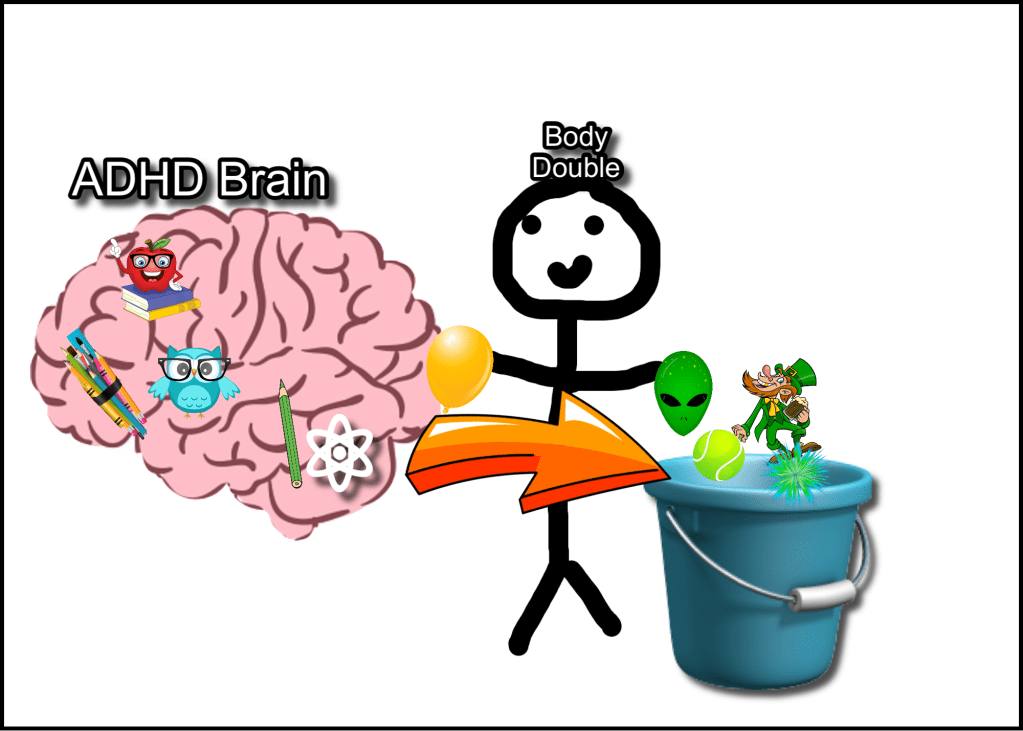
A really effective and quite simple way of just getting something done when you have ADHD is using a technique called body doubling. This is where you complete a task you might find challenging alongside someone else. By doing this, you can increase your motivation to do the task as having an anchoring presence to it can give you a sense of incumbency.

Personally, I find this really helps with studying. You could find people to revise or complete assignments with. Even going to a library ,where other people are studying, can give you the same agency and accountability. However, it’s important to note that if your body double has alternative motives, and isn’t trying to get work done with a certain intensity of focus, they can become more of a distraction than a help.

ADH-Tea and Coffee ☕️

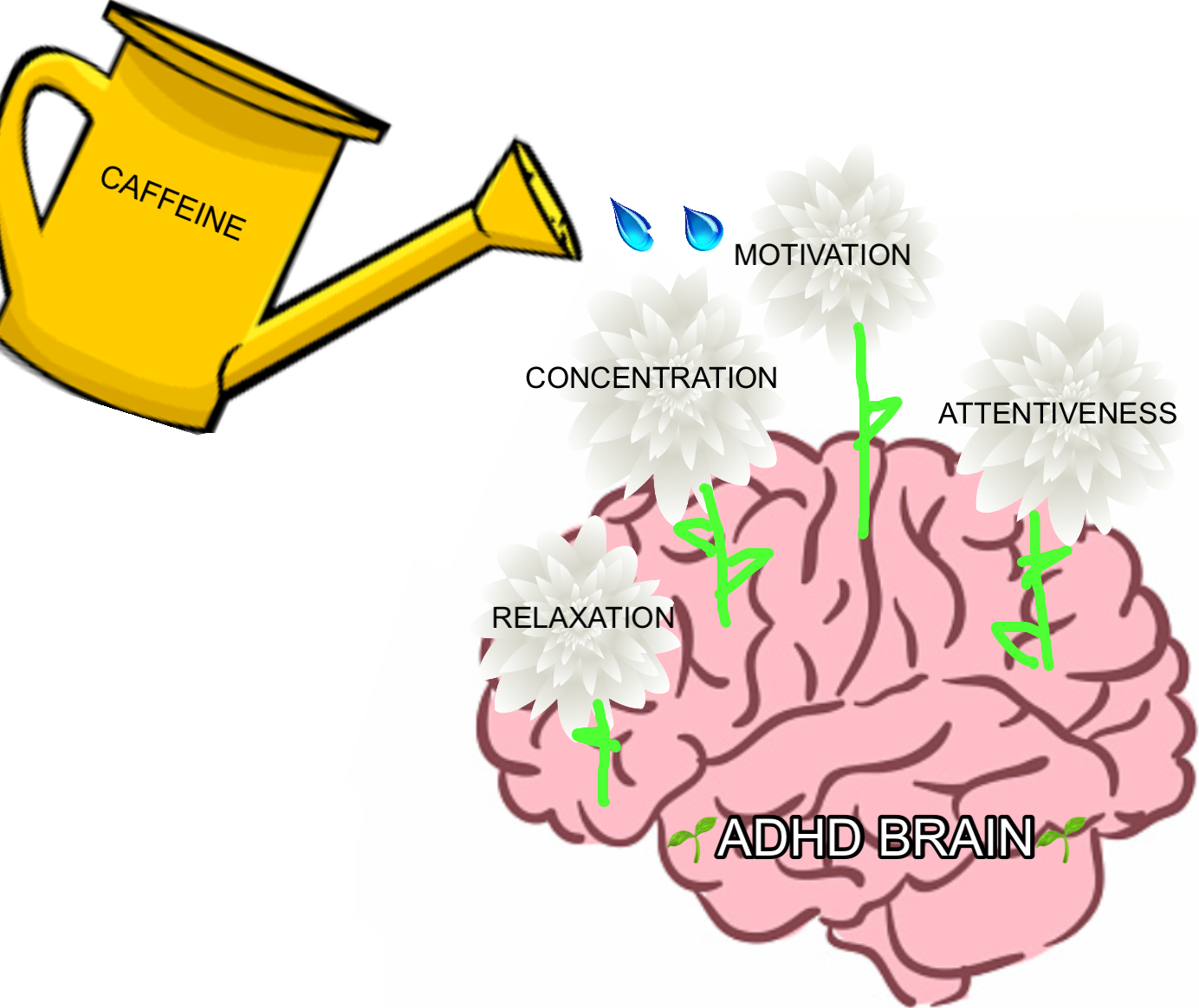
There’s a range of people with ADHD who would agree with me saying the prescription medication can be unpleasant. In my own experience, it can make you feel estranged from yourself and sort of numb. However, everyone’s personal experiences vary. But, if you’re like me, you might find that caffeine is the perfect loop-hole to get focussed on a task without medicating. Caffeine can be the perfect stimulant to relax and centre your mind, reducing disruptive symptoms of ADHD ( impulsivity, procrastination. Etc). It increases levels of the “happy hormone”, dopamine, in your brain, which is associated with motivation and attentiveness. In short, ADHD brains can thrive off stimulants. What makes someone without ADHD jittery can make someone with ADHD calm.

How Best To Use This

When starting an ADHD medication, often is the case that you have to work through several different doses to find what works best for you individually. Similarly, when I sit down to get something done, I sit with a cup of coffee or caffeinated tea to sip at until i reach my perfect level of concentration and maintain this through out. It’s also important to note that even if caffeine can have a positive affect on you, it doesn’t mean you should ignore the negative affects it can also have. Along with other side effects, Caffeine can induce anxiety (which already has high levels of comorbidity with ADHD), and can hurt under-developed brains. For more information, follow this link:

Medication and Caffeine.

In the words of Mark Twain “too much of anything can be bad”. Although stimulants can be essential to managing ADHD, don’t go rogue and over do it. Caffeine intake along with prescribed medication can ignite adverse side effects to a medication which already has so many regular ones. Check on your medication pamphlet or with your doctor/GP to see what works the best for you.

Why isn’t Female ADHD Taken Seriously?

Men and women are at an equal risk of having ADHD, despite this, around 50-75% of cases of female ADHD go undiagnosed. Perhaps this is because the stigmas surrounding ADHD suggest it’s more prevalent in men as the signs of female ADHD are less obvious and visible. Moreover, girls with ADHD are diagnosed on average five years later than boys. ADHD in women tends to fall under the radar which can be harmful as it can be the gateways to many more disorders. The dangers of ADHD lie in it’s high comorbidity levels, which are particularly prevalent in undiagnosed ADHD. Additionally, traits of ADHD in women can seem quite mundane, they seem like small challenges that every individual faces. This is only if you fail to acknowledge that these symptoms are both chronic, and heightened in people with ADHD.

My personal diagnosis story falls tribute to how overlooked ADHD is for girls; My younger brother, who is the ADHD archetype, was diagnosed first. With his diagnosis I decided to research a little into ADHD, and i found that a lot of it felt familiar to me. First and foremost, I spoke to my adults who were very quick to shut it down because my symptoms weren’t as visibly noticeable as my brother’s. Eventually, I got an appointment with an ADHD clinic near me. At the clinic they measured my ADHD based off of hyperactivity which poses problems as female ADHD is often more inattentive. They sat me in front of a computer and got me to complete various tasks and puzzles independently whilst secretly measuring movements in a single blind test. They also zero’d in on how i shake and bounce my legs when i was sat for a short interview. They were so focussed on the characteristics of ADHD more common in men that it was very apparent that general, and even professional understandings of ADHD are massively androcentric. However, when i was younger, my symptoms of ADHD were a lot more physical so i managed to hover just above the radar. When i was finally diagnosed at 15, i thought the hard part was over. However, my diagnosis wasn’t taken seriously.For instance, I attended the same school as my brother who had one to one help and resources such as a laptop given to him…the most i got was three five minute rest breaks in exams. It wasn’t until the final few months leading to my A-level exams ,when I went off the grid for over a month after crashing under the overwhelming scholarly pressures, that i had any attention. Overall, i’ve experienced first hand just how difficult it is to get female ADHD to even be acknowledged let alone helped.

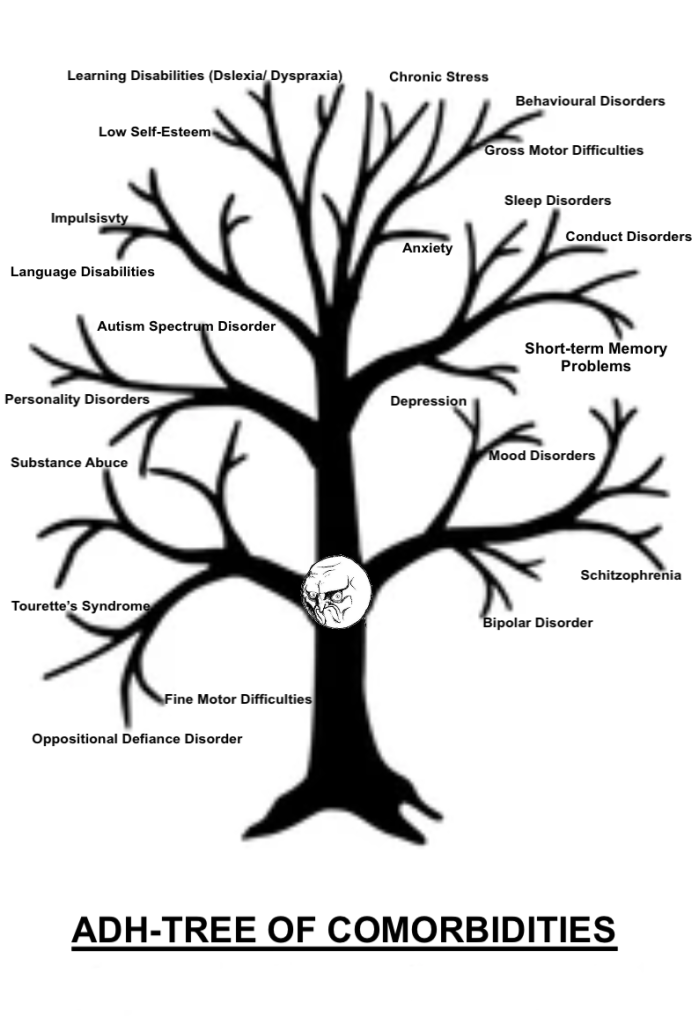
ADHD has very high comorbidity levels. This means that if you have ADHD, it’s likely you simultaneously have one or more disorders, conditions, or disabilities. The image above depicts some examples that have links to, or are comorbid with ADHD…

“Alarmingly, some studies estimate that as many as 50% to 75% of girls with ADHD are missed”- Adams, Caralee

“Worse, girls with ADHD are diagnosed on average five years later than boys–boys at age 7, girls at age 12.”- Adams, Caralee

Signs of Female ADHD

The stereotypical image of ADHD is someone bouncing off the walls, incapable of being still. However, women with ADHD are often a lot more inattentive than hyperactive. Motor symptoms of ADHD tend to go away at an early age for women, nevertheless, an underlying lack of mental focus remains. This can manifest itself in many ways such as:

  • Disorganisation
  • Troubles focussing
  • Difficulties with short-term memory
  • Difficulties with time management
  • Chronic stress
  • Low self-esteem

ADHD Study Tips

Having to sit down and focus on a piece of work can prove to be an uphill battle when you have ADHD, here are some tips I have acquired over my years as a student that can hopefully help you too…

  • Break down your work! You’re so much more likely to fall into a procrastination cycle if the amount of work you have to do feels endless or unattainable.
  • Have everything you need prepared at reach such as snacks and books so as to not give yourself reasons to procrastinate.
  • Turn off your phone if you can or put it on silent/ do not disturb.
  • Aim to study in places where other people are too, such as homework groups or libraries to motivate you.
  • Have soothing background music with no lyrics to drown out random and unnecessary trains of thought.
  • Ask your GP or therapist etc about medications if they may help you to concentrate.
  • See if caffeinated drinks help you to calm down and be mellow, if they do they’re a great study help.
  • Take a multi-sensory approach, for instance, you can highlight whist you read or listen to an audio version of a passage whilst reading so that you can be fully focussed on what you need to be.
  • If possible ask for extensions on your work.
  • If possible, take a course or a subject you enjoy so you feel more encouraged to study.
  • Make sure you have all the correct scholarly support systems available to you.
  • Use fidget toys if they help you.